
GAC 2026: What Top Aesthetic Practices Are Doing Differently
Most aesthetic practices don’t have a lead problem; they have a follow-through problem. Takeaways from four sessions at the Global Aesthetics Conference 2026.
Now accepting new clients for 2027. Find my lost consults
By Alex Zinni13 min read
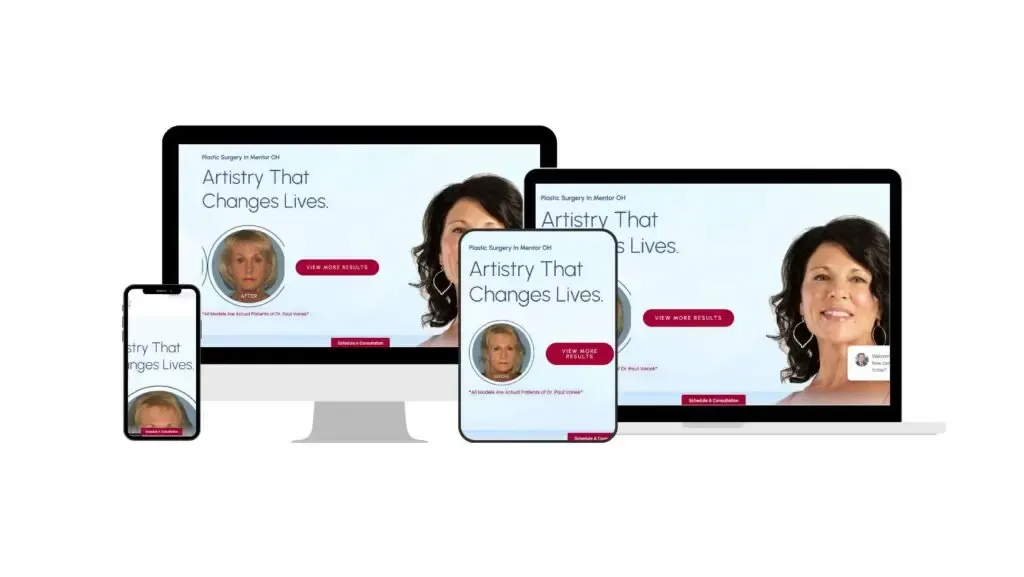
Your website is either turning strangers into booked consultations or quietly talking people out of calling you. There's no neutral. For a plastic surgery practice, the site is the first consult, and most patients form an opinion about you before they ever pick up the phone.
That's why generic web design advice falls short here. A plastic surgery website has to do things a plumber's site never will: show results without overpromising, build trust in a personal decision, handle sensitive patient data legally, and load fast while carrying a large library of high-resolution photos.
This guide covers what actually matters, which platform to build on, and the mistakes that cost practices patients. It's written for surgeons who are about to build or rebuild, not for people who want theory.
A plastic surgery website has to sell a transformation and a relationship at the same time, which almost no other medical site does. Patients aren't shopping for a commodity. They're choosing someone to change how they look and feel, so the site has to earn trust and show proof while staying compliant with medical privacy law.
Think about the mindset of the person visiting. They're often nervous, they've been researching for a while, and they're comparing you against several other surgeons in the same city.
They want to see real results, understand what a procedure actually involves, and get a feel for whether they'd be comfortable in your chair. A dermatology or dental site can lean on convenience and routine. Yours has to carry emotion, artistry, and credibility together. That combination is the whole design challenge.
It also raises the stakes on visuals. Your work is visual, your patients are making an aesthetic judgment, and stock photos of smiling models undercut you instantly. The practices that win online show their own results, their own space, and their own team.
The sites that convert do a handful of things well, and they do them on purpose. A striking homepage, real before-and-after results placed prominently, obvious credentials, clear and honest procedure information, and a booking path that never makes the patient hunt. Everything else is supporting cast.
Start with the first impression, because you don't get a second one. Right away, a visitor is deciding whether you look like a surgeon they can trust.
That means a clean, confident homepage, a real photo of you or your practice rather than a stock image, and a single clear next step. Clutter reads as amateur, and amateur is the last thing a patient wants in someone holding a scalpel.
Then there's the gallery, the most important page on most plastic surgery sites and the one practices most often get wrong. Patients want to see results for their specific procedure, filtered by procedure and ideally by surgeon. A gallery that makes them scroll through unrelated cases loses them.
Put it in the main menu, let people filter it, and make sure every image has proper patient consent behind it. That last point is covered in the HIPAA section, because it's where practices get into legal trouble.
Credibility signals matter more here than in almost any other industry. Board certification, hospital affiliations, society memberships, and genuine patient reviews all belong where people can see them without digging.
If you're board-certified by a recognized body, say so above the fold. The American Society of Plastic Surgeons and The Aesthetic Society are affiliations patients recognize and trust, and displaying them is one of the cheapest trust wins available to you.
Do I really need before-and-after photos?
Short answer: yes, and it's not close. Results are the single most persuasive thing on a plastic surgery website. A practice with a strong, well-organized gallery will usually out-convert one without, even if the second site is prettier. If you're not comfortable publishing photos, that's a conversation to have with your marketing team, but understand you're giving up your strongest asset.
Finally, remove friction from the booking path. A prominent "request a consultation" button on every page, a short form, and a fast response beat a clever design every time. The goal of the whole site is that button getting clicked.
Google and AI search engines don't just read what your site says. They judge whether to trust it. That judgment runs on E-E-A-T: Experience, Expertise, Authoritativeness, and Trustworthiness. For a medical site, weak E-E-A-T means you get buried, even with beautiful design.
In plain terms, it means proving a real, credentialed surgeon stands behind the site. That's your bio and board certification, your before-and-after results (which are literal evidence of experience), named authorship on any articles you publish, and genuine patient reviews.
This matters double now, because AI assistants cite sources they trust. A site with a named surgeon, clear credentials, and real results is one an AI tool will confidently recommend. A faceless site with no author and stock photos is one it skips.
The practical version: a detailed surgeon page with credentials and a real photo, bylines on your blog content, consistent practice name and contact details everywhere online, and visible links to recognized bodies like the ASPS or The Aesthetic Society. Credibility isn't just reassurance for patients. It's a visibility strategy.
The best platform for most serious plastic surgery practices is WordPress or Webflow. WordPress wins if you plan to grow through content and SEO and want full ownership. Webflow wins if design distinctiveness and low-maintenance speed matter most. Squarespace and Wix are fine for small, simple practices, and you should be cautious about any vendor that won't let you own your site.
Here's the honest breakdown, because every option involves a real trade-off.
WordPress runs a large share of the web for good reason. It's flexible, it scales, and its ecosystem handles everything a growing practice needs: procedure pages, a real blog, advanced SEO, galleries, financing integrations, and CRM connections.
The catch is that WordPress rewards discipline. A cheap theme stuffed with plugins will be slow and fragile, and it needs ongoing maintenance and security attention. Built well, though, it's the strongest long-term foundation for a practice that intends to invest in growth. This is the platform we most often recommend for surgeons serious about SEO and content.
Is WordPress good enough for a plastic surgery site? It's more than good enough. It's a common platform among medical practices. The quality comes from how it's built, not from the platform itself. A disciplined custom build on WordPress will outperform almost anything. A bloated one will drag.
Webflow has become a genuinely strong option for design-forward practices. It gives you custom, designer-grade layouts without the plugin bloat that slows WordPress down, and it produces clean, fast-loading code out of the box. The trade-offs: a steeper learning curve for whoever maintains it, hosting tied to Webflow, and a smaller medical-specific ecosystem. If a distinctive, high-end look and strong performance are your priorities and you don't need a sprawling content operation, Webflow is a smart pick.
Squarespace makes beautiful, low-maintenance sites quickly, and for a boutique solo practice with a short list of procedures, that can be enough. Where it struggles is scale and depth: large procedure libraries, advanced SEO control, and sophisticated gallery filtering are all weaker than on WordPress or Webflow. Good for simple. Limiting for ambitious.
Wix has improved a lot and is a low-cost, easy way to get online. For a brand-new practice on a tight budget, it's a reasonable starting point. Just know you'll likely outgrow it, and migrating later is work you'll have to pay for eventually.
These deserve a specific warning. Some agencies build on proprietary platforms or lease you the site rather than handing over ownership. The convenience can be real, but read the contract. If you don't own your website and its content outright, you're renting your most important marketing asset, and switching providers later can mean starting from scratch. Full ownership should be non-negotiable.
If you take one thing from this section: pick the platform that matches your growth plan, not the one that's cheapest this month.
Every procedure you offer needs its own dedicated page, built to answer one patient's questions about one procedure and lead them to book. A single "our services" page that lists everything will neither rank in search nor convert the patient who's specifically researching a rhinoplasty tonight.
A procedure page that works usually follows this shape:
The practices that treat each procedure page as a real answer to a real question, rather than a thin stub, are the ones that show up when patients search and when AI assistants recommend surgeons.
Many patients find a surgeon by searching, on Google or increasingly through AI assistants. Search engine optimization (SEO) is what decides whether you show up. Design gets people to book once they arrive. SEO is what gets them there in the first place.
The foundation is the structure covered above: a dedicated, in-depth page for every procedure, written around the questions patients actually ask. Those pages are your SEO. A thin site with one catch-all services page has almost nothing to rank.
Local signals matter too, since plastic surgery searches are usually tied to a city. A complete Google Business Profile, your service areas named on the site, and consistent contact details across the web all help you surface in your market.
And write for humans first. Google and AI both reward genuine, expert content over keyword-stuffed filler. This is a slower game than design, and it compounds. If you want it handled properly, it's the core of our plastic surgery SEO work.
The moment your website collects a name, email, or health detail through a form, it's handling protected health information, and that pulls you into HIPAA territory. Getting this wrong isn't a design problem. It's a legal and financial risk, and it's the part most web designers quietly skip.
Three things need to be right. First, any contact or consultation form has to transmit and store data securely, which means encryption and a form or CRM provider willing to sign a Business Associate Agreement (BAA). A standard off-the-shelf form plugin often won't cut it. Second, before-and-after photos require documented, procedure-specific patient consent to publish, and that consent needs to be on file, not assumed. Third, your hosting and any connected tools handling patient data have to meet the same compliance bar. The U.S. Department of Health and Human Services publishes the actual HIPAA rules, and enforcement is real, so this is worth doing properly with people who understand it.
This is specialized enough that it's worth its own conversation. If you want the full picture, our guide to HIPAA-compliant website design covers it in depth.
Speed, mobile experience, and accessibility are the technical basics that directly affect whether patients stay and book, and they're where image-heavy plastic surgery sites most often fail. A gorgeous site that loads slowly on a phone is losing you consults you'll never even know about.
Page speed is the big one for this field specifically, because your galleries are heavy. Google measures real-world loading and stability through Core Web Vitals, and large, unoptimized images are the usual culprit behind a failing score. Properly compressed images, modern formats, and lazy loading let you keep a rich gallery without the load-time penalty. Since many patients will find you on a phone, mobile-first design isn't optional. It's the default your site should be built around.
Accessibility rounds it out, and it's both the right thing to do and a legal consideration. Building to the Web Content Accessibility Guidelines means patients using screen readers or navigating without a mouse can still use your site, and it reduces your exposure under the Americans with Disabilities Act. It also happens to make your site cleaner and easier for everyone.
For a plastic surgery practice serious about growth, a custom build is worth the extra cost, and here's the reasoning. A template gets you online fast and cheap, but it also makes you look like every other practice using that template, limits your SEO control, and boxes in your gallery and procedure pages exactly where you need flexibility most. A custom build costs more and takes longer, but it's designed around your brand, your procedures, and your growth plan, and you own it completely.
The cost of a polished custom build for a plastic surgery practice depends on the number of procedures, gallery complexity, and integrations. Templates cost less. The right question isn't which is cheaper. It's which one pays you back in booked consultations, because a site that converts is an investment, not an expense.
The timeline for a quality custom plastic surgery website depends on scope, and it runs longer if you're producing new photography and writing detailed content for many procedures. Anyone promising a great custom medical site in a few days is selling you a template.
If you're building or rebuilding, get the order right. Choose a platform that fits your growth plan, and lean toward WordPress or Webflow if you're serious. Make results and credibility impossible to miss. Give every procedure its own real page. Get the HIPAA and technical foundations right the first time, because retrofitting them is painful. Do those things and your website stops being a brochure and starts being your hardest-working salesperson.
Beyond SEO, digital marketing for plastic surgeons can bring together content, paid advertising, social media, and other online strategies to help potential patients find and connect with your practice.
That's a lot to coordinate, and most surgeons are busy operating, not managing web builds. If you'd rather have a team that does this for aesthetic practices handle it end to end, that's exactly what we do.
Take a look at our cosmetic surgery website design service, or book a 20-minute call and we'll tell you honestly where your current site is losing consults.
Yes. Results are the most persuasive element on the site. A well-organized, filterable gallery with proper patient consent is often one of the strongest drivers of consultation requests.
WordPress and Webflow are the strongest choices for practices focused on growth and SEO. Squarespace and Wix work for smaller, simpler practices. Avoid any vendor that won't give you full ownership of your site.
If it collects patient information through forms or displays patient photos, yes. You need secure, compliant form handling, a signed BAA with your form or CRM provider, and documented consent for any before-and-after images.
A custom build costs more than a template, and the amount depends on complexity. The better measure is return: a site that books consultations pays for itself.
It depends on scope. A quality custom build takes longer if new photography and extensive procedure content are involved.
Most aesthetic practices don’t have a lead problem; they have a follow-through problem. Takeaways from four sessions at the Global Aesthetics Conference 2026.
How dermatology website design affects patient conversions, with practical tips and seven real practice websites worth studying.

Eight common SEO mistakes that keep medical practices out of search results, and how to find and fix each one.
Book a 20-minute call. We will look at where your leads come from now, where they get lost, and what a full calendar would take.